AI has fundamentally changed the way we work. Most industries have been affected by it, and solar engineering is no exception.
There is a lot of discussion around how AI will change engineering, what it can automate, and how much of the work we do today could eventually be handled by AI. It is exciting, but it is worth taking a step back and asking a simpler question: How to find the right balance between AI-enabled automation and traditional tools & engineering expertise?
Having spent a good part of my career working across solar design, engineering, and project delivery, I have seen how much time goes into both the engineering itself and the work that surrounds it. Some of that work is repetitive and follows well-defined rules. Some involves gathering and organizing large amounts of information. And some requires experience, context, and judgment that are difficult to put into a set of rules.
I think the opportunity lies in understanding these differences.
First, let's look at the engineering process
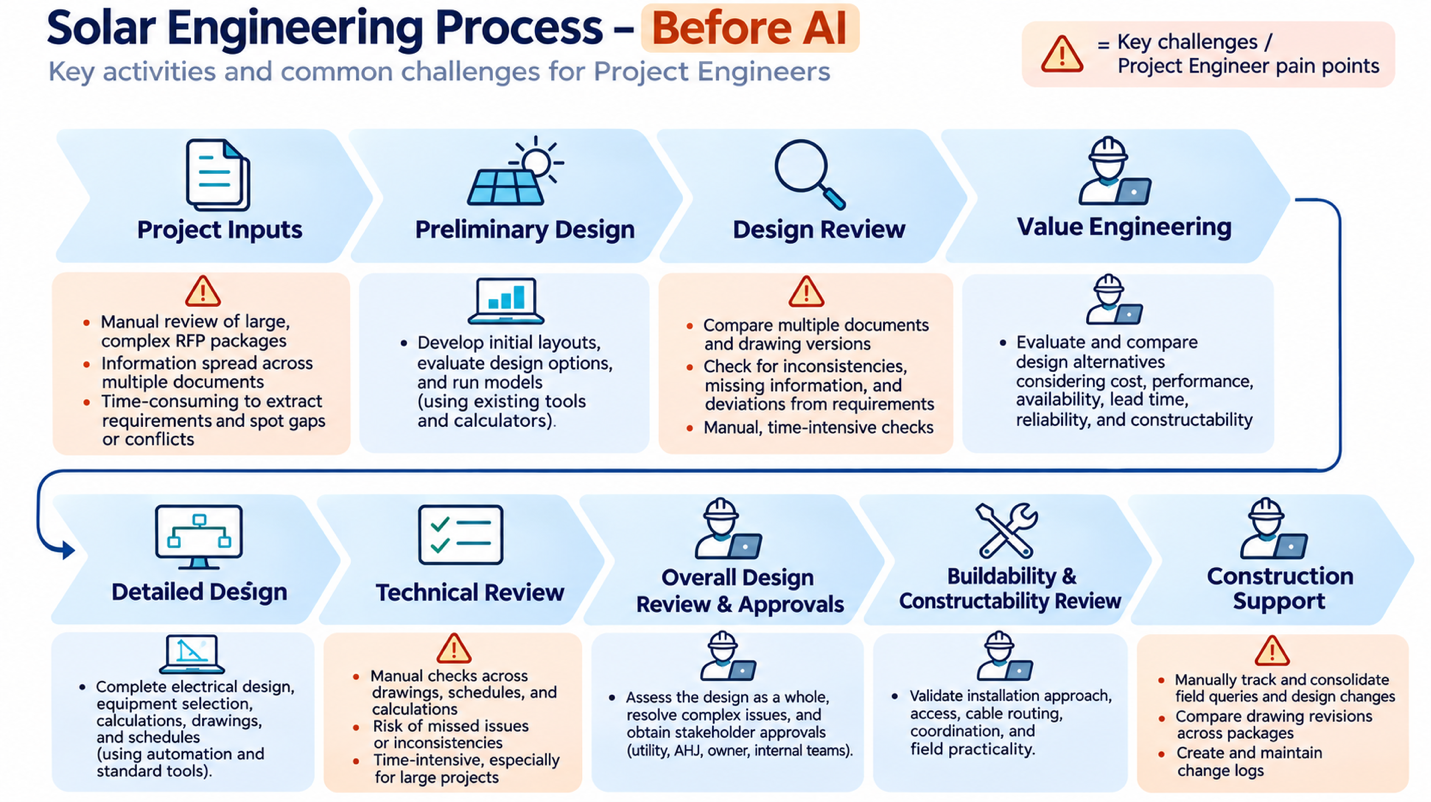
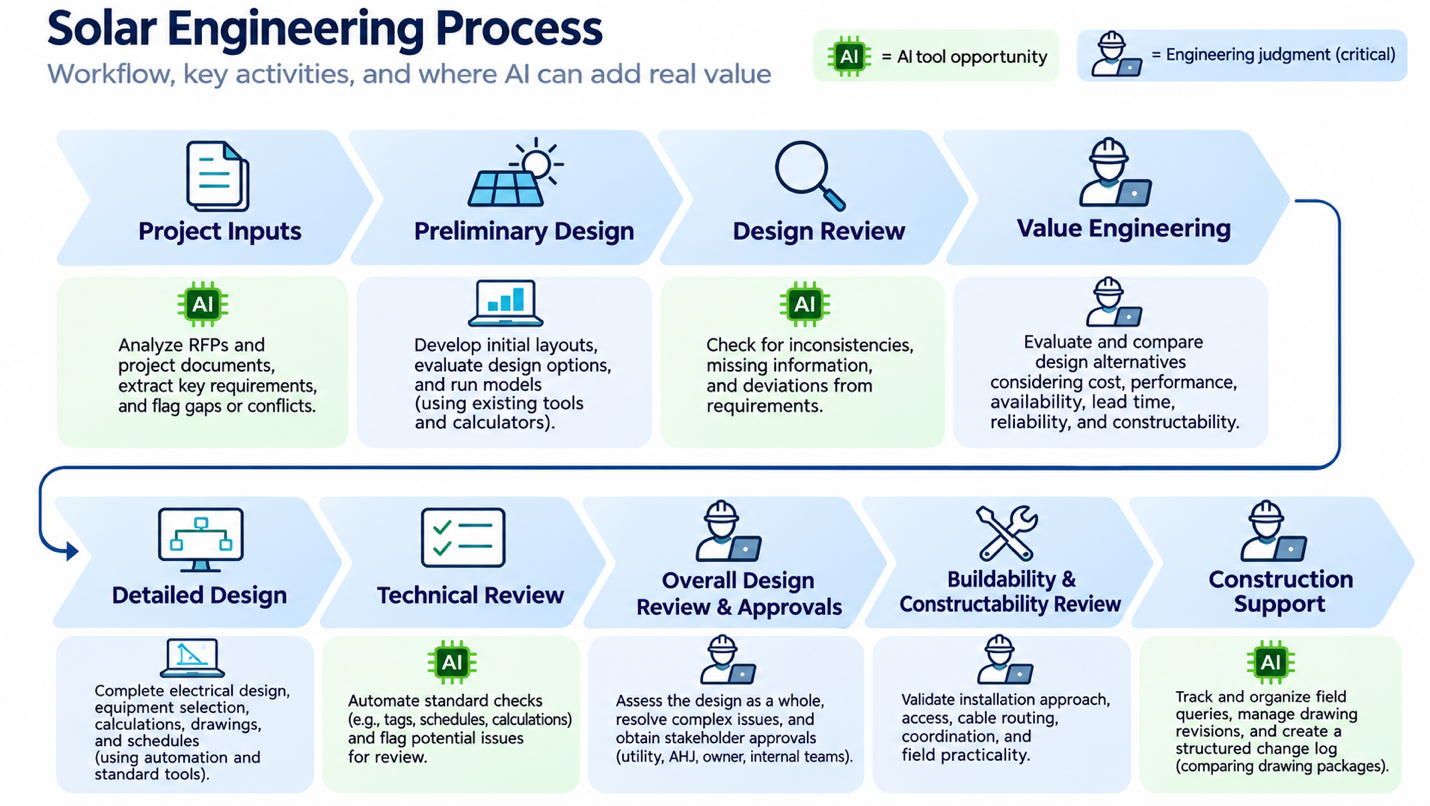
Solar engineering involves several stages, from understanding project requirements to developing the design, getting it reviewed and approved, and supporting the project through construction.
Each stage has its own set of tasks and challenges.
- Project inputs and requirements: Reviewing RFPs, site information, utility requirements, specifications, equipment data, and project constraints.
- Preliminary engineering: Developing initial layouts, evaluating design options, running models, and establishing the broad design approach.
- Detailed design: Working through electrical design, equipment selection, calculations, drawings, schedules, and design documentation.
- Reviews and approvals: Responding to comments from utilities, Authorities Having Jurisdiction (AHJs), engineering managers, and other project stakeholders.
- Construction support and revisions: Addressing field queries, incorporating changes, coordinating drawing updates, and maintaining accurate project documentation.
There is engineering work at every stage, but there is also a fair amount of time spent collecting information, checking documents, transferring data, tracking comments, and updating records. That distinction is important when we start thinking about automation.
Choosing the right tool for the job
Not every repetitive task needs AI. In fact, I would argue that one of the biggest mistakes we can make is trying to introduce AI into a process simply because we can. Solar engineering has been using automation for years. We have Excel-based calculators for conductor sizing, voltage drop, string sizing, and equipment schedules. We have scripts and web tools that help generate drawings, check calculations, and standardize repetitive tasks.
These tools work well because the underlying logic is known and predictable. If a calculation can be handled reliably through a spreadsheet or a simple script, there may be very little reason to replace it with an AI solution.
It helps to look at the available options as a progression:
- Manual work: When the task requires engineering judgment or is too specific to automate economically.
- Spreadsheets and calculators: For repeatable calculations with clearly defined inputs and outputs.
- Scripts and rule-based automation: When a process has consistent steps and needs to be repeated at scale.
- APIs and integrations: When different software systems need to exchange information without someone manually moving data between them.
- AI and AI agents: When the work involves interpreting documents, extracting information, comparing content, or coordinating multiple steps that are harder to define through fixed rules alone.
There is also an interesting discussion happening in software engineering around when to use an API versus newer approaches such as MCP. The underlying question is similar: what is the simplest and most reliable way to get two systems to work together?
The same thinking applies here. We should not make a process more complicated just to use a newer technology. The goal should be to solve the problem with the right tool, not necessarily the most sophisticated one.
Where AI can make a real impact
While calculations and design automation have their place, I see some of the biggest opportunities in the work that happens around engineering. These are tasks that often consume a lot of time but don't necessarily require an engineer to make a new technical decision at every step.
Here are three examples.
1. Making sense of large RFP packages
Anyone who has worked on a large solar project will know how much information can be buried in an RFP package. It could include dozens of documents: technical specifications, site plans, utility requirements, equipment datasheets, design criteria, commercial assumptions, and project-specific instructions. Important information may be spread across several files, and sometimes the documents don't even agree with each other.
An engineer has to go through all of this, identify what matters, and translate it into a set of inputs that can be used for engineering.
This is a good opportunity to develop an AI agent for your company.
Imagine being able to upload the complete project data room and have an AI agent review the documents, populate a design-input checklist, identify where each piece of information came from, and flag missing or conflicting requirements.
The engineer would still review and validate the information. But instead of spending hours searching through documents and manually transferring information into a checklist, they could start with a structured summary and focus their time on the things that need attention.
2. Automating engineering comment logs
Another problem area for engineers right now is the handling of engineering review comments.
On a typical project, comments can come from several directions: the utility, the AHJ, the engineering manager, the owner's engineer, or an internal review team. They may arrive as PDF markups, emails, spreadsheets, be raised verbally during meetings, or appear as comments in a project review platform.
A Project Engineer then has to go through these comments, consolidate them, identify which drawings are affected, remove duplicates, and organize everything into a comment log so that the team can work through them. The Project Engineer also has to track their resolution across the different engineering disciplines.
An AI agent could bring all these comments together, categorize them, identify the affected drawings and engineering disciplines, and generate a structured comment log. It could also help track open comments, highlight overdue items, and identify comments that may have been missed or not fully addressed.
The impact goes beyond saving time on preparing a comment log. It gives the Project Engineer better visibility into the status of reviews, helps ensure comments don't fall through the cracks, and makes it easier to coordinate resolution across the project team.
The engineer still needs to interpret the comments, decide how to address them, and approve the response. AI helps keep the review process organized and moving.
3. Comparing drawing revisions and generating change logs
Drawing revisions are another area that can take up a surprising amount of time.
When a new drawing package comes in, someone has to compare it with the previous revision and understand what has changed. This could involve equipment locations, electrical details, layouts, schedules, notes, or other design information.
Depending on the size of the project, this can be a fairly time-consuming exercise. It is also easy to miss a change when there are multiple drawings and several revisions involved.
An AI agent could help compare two drawing packages and generate a structured change log showing what has changed and where.
A well-maintained change log also serves an important purpose long after the project is completed. It provides a record of how design changes evolved and propagated through the project, including why a change was made and whose request triggered it. This becomes particularly useful when dealing with change orders involving subcontractors or the customer, as it provides a clear history of the changes and helps keep project financial accounting straightforward.
Again, the value is not in removing the engineer from the process. It is in reducing the time spent identifying and documenting changes so that the engineer can focus on understanding their impact.
Where we still need engineering judgment
For all the opportunities above, there is one distinction we should be careful not to lose: not every engineering decision can or should be automated.
Take value engineering, for example. Rather than asking AI to arrive at the final answer, we can use it to explore multiple design options and evaluate the trade-offs between them. AI could help generate alternatives, compare costs and modeled energy yields, and highlight considerations such as equipment availability, lead times, reliability, maintenance, and ease of installation.
The engineer can then use their experience and judgment to evaluate these options, select the most suitable approach, and refine the design to meet the specific needs of the project. AI can help broaden the options we consider, but choosing the right solution still requires engineering experience.
Drawing reviews are no different. There are plenty of checks that can be automated. We can look for missing information, inconsistent equipment tags, mismatches between drawings and schedules, calculation errors, or deviations from defined project requirements. These checks are useful, and they can catch mistakes that might otherwise be missed.
But a drawing package can pass every automated check and still not be a good design. An experienced engineer looks beyond individual checks. They understand how the different parts of the system work together. They think about assumptions, coordination between disciplines, constructability, cable routing, equipment access, and the practical challenges that may come up during installation.
These are things that come from working on real projects and understanding how designs translate into something that actually gets built.
I see AI as a tool that can make an engineer more effective, not a replacement for that experience.
Making AI adoption work across teams
As companies start adopting AI, it is important to move beyond individual engineers experimenting with AI chatbots and developing their own ways of doing things in silos. That may seem expedient to get started, but it is unlikely to be the most effective approach at a team level in the long term.
A better approach is to develop AI agents around your company's engineering processes, requirements, and standards, and make them available consistently across the team. This allows the organization to build on what works, improve it over time, and ensure that everyone benefits from the same capabilities.
As AI agents become more capable, the competitive advantage will not come simply from using more AI. It will come from knowing where to apply it, integrating it intelligently into engineering processes, and maintaining the discipline to keep human judgment where it matters.
The goal is not to remove engineers from the process. It is to remove unnecessary repetitive work from their day, so they can spend more of their time doing the engineering that actually matters.